
XENONnT Achieves a Historic Breakthrough: The First Measurement of Solar Neutrinos via Neutrino-Electron Elastic Scattering at the keV Scale
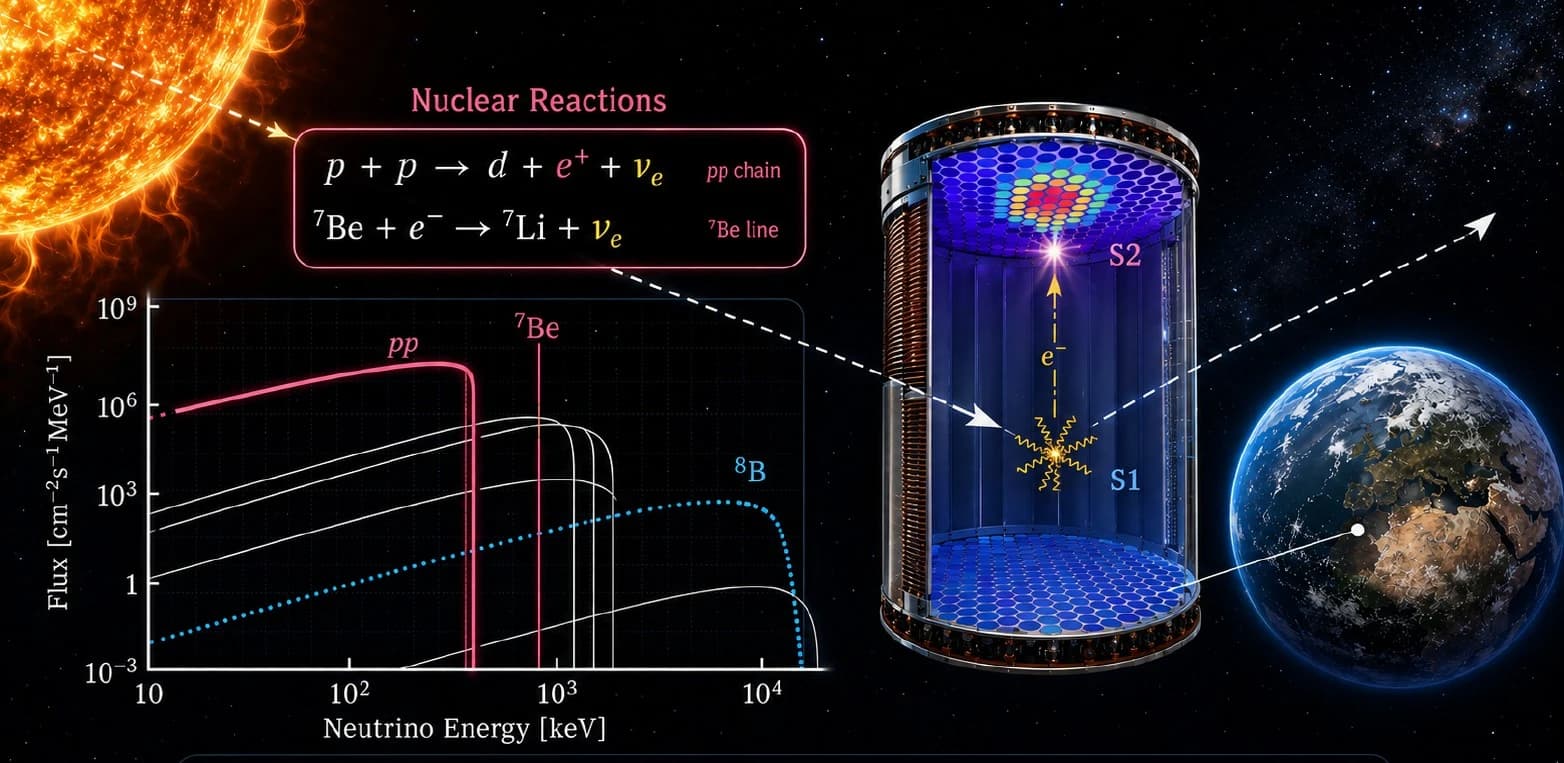
On August 31, 2026, the XENON collaboration announced a major result: for the first time, the XENONnT detector, located at the Gran Sasso National Laboratories in Italy, successfully detected low-energy solar neutrinos, with a record-low detection threshold of just 17 keV (kiloelectronvolts). This is the lowest threshold ever achieved for the direct detection of these particles. This achievement was made possible, in part, by the involvement of members of the XENON team at SUBATECH, who contributed significantly to this result, particularly through their expertise in low-energy calibration. The observed signal is dominated by pp neutrinos, produced by the proton-proton fusion reactions that power the Sun and constitute the vast majority of the neutrinos emitted by our star.
This measurement is not only a milestone for XENONnT but is part of a long tradition of solar neutrino studies conducted at the Gran Sasso Laboratories. In the 1990s, the GALLEX/GNO experiments measured the flux of low-energy solar neutrinos for the first time using radiochemical techniques. Later, Borexino broke new ground by observing, in real time, the interactions of solar neutrinos with an energy threshold of 335 keV. Today, XENONnT lowers this threshold to 17 keV, opening up new frontiers in the exploration of these elusive particles.
The technologies developed for XENONnT are not only used to search for dark matter but also pave the way for a new generation of observatories. This observation demonstrates how innovations stemming from dark matter research open entirely new windows onto the Universe. The technologies developed to observe some of nature’s rarest phenomena now allow us to explore fundamental questions that go far beyond the initial scientific objectives.
Open access to the paper: https://xenonexperiment.org/wp-content/uploads/2026/08/XENONnT_Solar_pp_compressed.pdf