
Solid Characterization
X-Ray Diffraction (XRD)


Laser ablation coupled to HR-ICP-MS (LA-HR-ICP-MS)

Fourier Transform Infrared Spectroscopy (FTIR)

Total Carbon (TC) Analysis


X-Ray Diffraction (XRD)
D8 Advance ECO (Bruker)
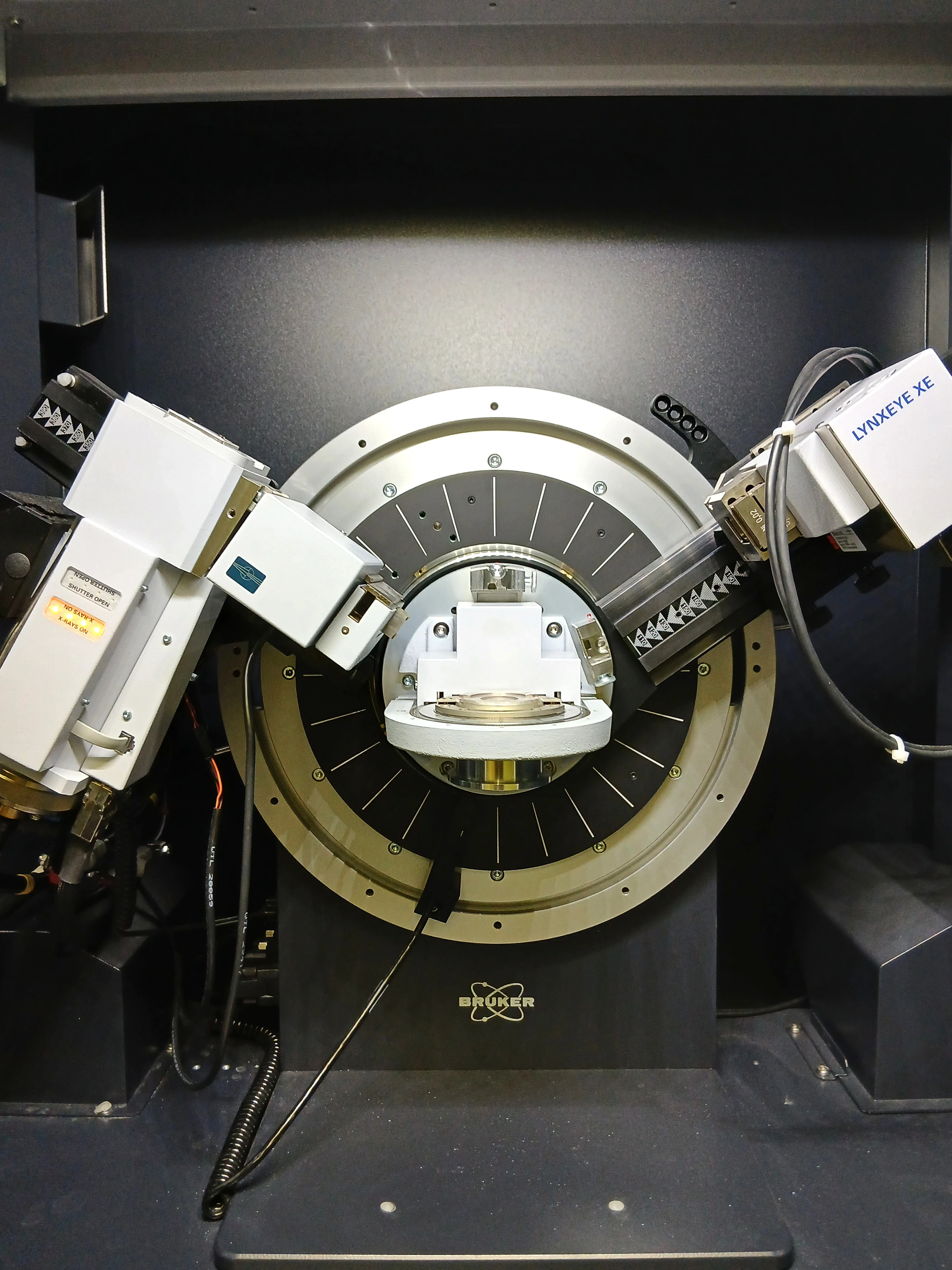
Description
X-ray diffraction (XRD) is a non-destructive structural analysis technique based on the interaction of X-rays with the crystal lattice of a sample. Analysis of the resulting diffraction pattern provides the following information:
- Identification of crystalline phases.
- Qualitative and semi-quantitative analysis of mineralogical assemblages.
- Estimation of crystallite size.
The instrument can analyze a wide variety of samples, including powders, bulk materials and radioactive samples, using different sample holders and suitable experimental configurations. Analyses can be performed under controlled or inert atmospheres. Measurements are carried out in θ/θ geometry, with a typical sample quantity of approximately 300 mg for powders.
Applications
- Glass (ISG, MA-VL, SON 68), cement (CEM-I, CEM-V), geopolymers, steels, oxides (Th, U, Zr, Fe, Al, etc.), clays (illite, montmorillonite, etc.) and targets (Gd).
Laser ablation coupled to HR-ICP-MS (LA-HR-ICP-MS)
UP213 (New Wave Research)

Description
The laser ablation system is a sample introduction device used for elemental and isotopic microanalysis of solid samples. The laser is a solid-state Nd:YAG (neodymium-doped yttrium aluminium garnet) laser operating in the deep UV at a wavelength of 213 nm.
The laser delivers pulses of approximately 4 ns at an adjustable repetition rate of 1 to 20 Hz. The energy per pulse is greater than 3 mJ (fluence > 30 J/cm²). The optical system can focus or image the laser beam onto the sample using different operating modes.
The standard ablation cell is mounted on a bidirectional motorized XY stage. Trigger mode enables automatic acquisition of analyses. The sample is visualized using a microscope/CCD system under reflected or transmitted light.
Applications
- Elemental profiling and elemental microanalysis of various solid matrices: environmental samples, radioactive waste storage materials (clay, glass, cement and steel) and mineral phases.
Fourier Transform Infrared Spectroscopy (FTIR)
Invenio S (Bruker)

Description
Fourier transform infrared spectroscopy (FTIR) is a characterization technique used to identify the chemical functional groups present in a material. It is based on the absorption of infrared radiation by the vibrational modes of chemical bonds, producing a characteristic spectrum of the sample.
The Bruker INVENIO S spectrometer provides high spectral resolution, excellent sensitivity and a spectral range from 4000 cm⁻¹ to 400 cm⁻¹ in the mid-infrared region. It can analyze solids, liquids and powders with limited sample preparation, particularly through the use of ATR mode.
The instrument includes the following accessories: diamond ATR (attenuated total reflection), an xyz sample stage, transmission sample holders and transmission heating capabilities (up to 180 °C).
Applications
- Identification of chemical functional groups (H₂O, OH, CO₃²⁻, C=C, Fe–O, Al–O, Si–O, etc.).
- Monitoring of chemical transformations (reaction, alteration and hydration).
- Characterization of organic and inorganic materials.
Total Carbon (TC) Analysis
HT1300 / Module solide (Analytik Jena)

Description
The HT 1300 module enables TC and TOC analyses (after acidification with 2 N HCl to remove inorganic carbon, followed by drying) of dry solid samples in the form of pieces, shavings, powders or pastes. The sample is weighed (up to 3 g) and then placed in a ceramic boat.
The carbon contained in the sample is converted into CO₂ by thermal oxidation in a combustion furnace at 950 °C or 1200 °C depending on the silica content, and is then transported by the carrier gas (O₂) to the NDIR detector.
Prior calibration using dry Na₂CO₃ or CaCO₃ salts is used to relate the peak area to the carbon concentration. The carbon quantification limit is approximately 1 mg/kg.
Applications
- Determination of total carbon (TC) and total organic carbon (TOC) from a minimum concentration of 1 mg/kg.
- Soil, sediment and cement samples.